Related Posts

MSD Shaz Com Online
Online Learning with Gadgets
Online Learning with Gadgets
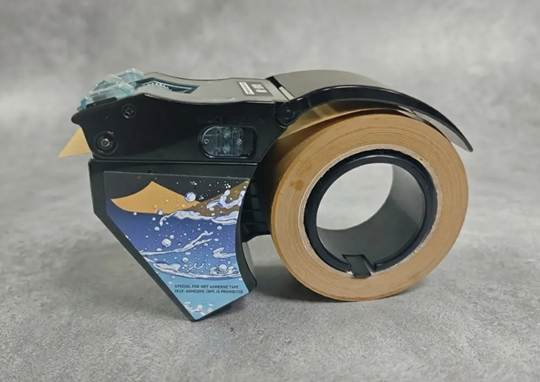
Water-activated kraft paper tape only bonds when the starch adhesive is moistened correctly and pressed into the corrugated fibers. That single fact makes the dispenser tape pairing more consequential than most packaging equipment purchases. A dispenser that wets unevenly, cuts raggedly, or fits the wrong roll width will produce cartons that look sealed and fail in transit.
Air Power Pak’s dispenser range spans four operating styles. The differences between them matter less than whether the chosen unit matches daily carton volume, tape specification, and the physical layout of the packing station.
The Handheld Case: Portability Has a Specific Use
The GHC-50 is a manual handheld unit with an 80 ml reservoir, a brush moistening system, and a supported tape width of 50 mm with a maximum roll diameter of 140 mm. It weighs roughly 330 g and requires no power connection. The intended setting is small-to-medium e-commerce fulfillment, retail backrooms, and light warehousing where cartons are sealed in batches rather than in a continuous stream.
The practical limitation is not the absence of a motor. It is that output depends entirely on operator rhythm. A steady pull gives the brush time to transfer moisture evenly. A fast, jerky pull leaves dry patches that never bond properly. Buyers considering this unit should test it with their actual tape before committing, because the GHC-50 is designed for standard non-reinforced kraft tape, and reinforced tape may feed less smoothly.
The Bench Manual Case: Standardization Without Electronics
The NT-800 is a lever-operated bench unit supporting tape widths from 20 to 100 mm, custom lengths up to 1000 mm, and roll diameters up to 200 mm. A single water fill is sufficient for roughly 100 to 200 standard cartons, according to the manufacturer’s specification. The lever mechanism dispenses a set length with each pull, which standardizes sealing across operators without introducing circuit boards or sensors.
This is the model that fits operations transitioning from plastic tape guns but not yet ready for automated dispensing. It is also the unit most likely to be specified incorrectly: buyers sometimes order it expecting automatic length selection, when in fact the operator sets the length and pulls the lever. That is a feature, not a defect, for teams that want predictable tape consumption, but it is a mismatch for high-throughput lines.
The Automatic and Sensor Cases: Where Speed Justifies Complexity
The NT-AT 3.0 addresses the bottlenecks that appear once volume climbs. It supports a 3.5 L water tank, tape delivery at 60 m/min, and a shutoff sound level below 75 dB. The larger tank reduces refill interruptions, and the delivery speed means one meter of tape dispenses in under a second. For cross-border e-commerce sellers shipping hundreds to thousands of orders daily, that throughput difference is the reason to move beyond manual units.
The sensor-operated Tape-AT shifts the trigger from a button to hand proximity. It outputs tape at an average of 60 m/min and uses a 2.5 L water tank with adjustable water temperature from 0 to 80°C. The ergonomic case angle is set at 45 degrees, which reduces shoulder strain during extended operation. This matters in workstations where the operator is holding a carton steady with one hand and cannot easily press a button with the other. It adds little value where cartons sit flat on a bench during sealing.
The Accessory That Solves a Real Daily Problem
The tape length detector, model UM-CJ01, measures a carton placed near it and calculates the required tape length, with detection distance from 3 to 200 cm and accuracy within 1 cm. It is compatible with the NT-ATv2.0 model. Manual estimation produces two failure modes that never appear dramatically in a cost report: tape cut too short, requiring a second piece that weakens the seal, and tape cut too long, wasting material on every carton. For operations sealing thousands of cartons weekly, the detector is worth evaluating before scaling up.
What to Confirm Before Ordering
Tape width is the most common specification error. Confirm the roll width against the dispenser’s supported range before placing the order, especially if existing tape inventory is already on hand. Roll diameter matters for the same reason: a large roll that does not fit the holder either goes unused or forces a return.
The second confirmation is the water system’s maintenance routine. On the GHC-50, the brush should be rinsed weekly to clear dust and adhesive residue, and the reservoir emptied before extended idle periods. Bench and automatic units have larger tanks but the same principle applies: moistening consistency, not water capacity, governs seal quality. A dispenser that wets one edge more heavily than the other will produce corner lift-offs regardless of tank size.
For distributors and resellers, supplier support is a specification item rather than an afterthought. Air Power Pak offers OEM/ODM options on selected models, including logo printing and body color, with minimum order quantities that vary by model and project requirements. Sourcing dispensers and compatible kraft tape from the same supplier simplifies matching, but tape specifications and MOQs should be confirmed before bulk orders.
The Decision Framework
No single dispenser tape setup suits every operation. The handheld GHC-50 fits flexible, lower-volume packing. The NT-800 fits teams that want standardized lengths without electronics. The NT-AT 3.0 and sensor-operated Tape-AT fit repetitive, higher-volume sealing where throughput and reduced operator effort justify the added complexity. The correct choice starts from carton count on the busiest shift, confirms tape width and roll diameter, and then selects the operating style that matches how the packing station actually runs.



 Does Proxy Bay Typically Make You Feeling Silly?" title="Does Proxy Bay Typically Make You Feeling Silly?"/>